
From Curiosity to Commercialization: The R&D Journey of Mykola Maksymenko
How do you bridge the world of theoretical physics with real-world impact?
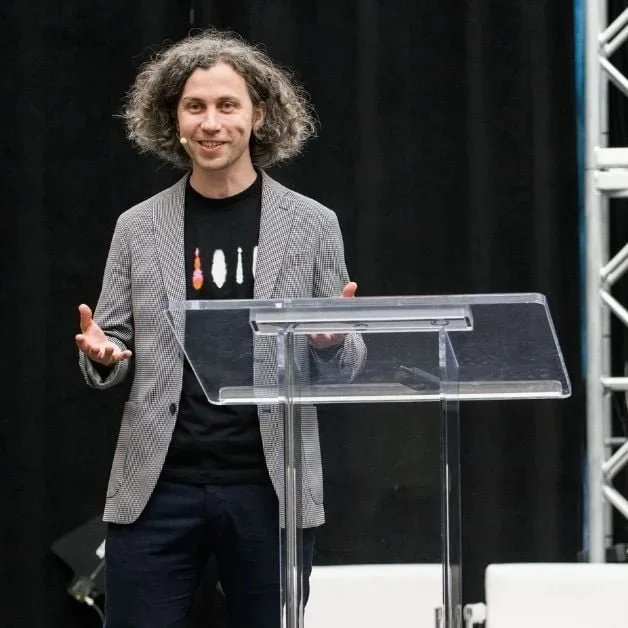
In the final interview of our podcast series on R&D Management and Technology Commercialization, Andros Zacharia speaks with Mykola Maksymenko—a physicist, quantum computing entrepreneur, and co-author of R&D Management and Technology Commercialization. His story takes us from curiosity-driven research to the leadership of frontier-tech startups and innovation teams.
Here are some powerful takeaways from the conversation:
1. Curiosity Isn’t Optional—It’s the Foundation
For Mykola, curiosity isn’t a personality trait—it’s a professional requirement. Whether building quantum algorithms or tactile holograms, he sees genuine curiosity as the core competency of successful R&D professionals.
“It’s curiosity that drives you through the hard problems. Without it, you give up too quickly.”
His hiring philosophy reflects this: he looks for people who ask questions, who explore deeply, and who remain persistent even when results don’t come easy.
2. Communication is a Superpower—Even in Deep Tech
Working in quantum computing, Mykola knows how easy it is to get lost in complexity. That’s why his team places a surprisingly strong emphasis on communication skills—not just internally, but with customers and markets.
“Engineers must learn to package their work. If you can’t explain your breakthrough, no one can use it.”
In frontier domains like quantum computing and AR, where public understanding lags, the ability to educate and inspire is part of what makes a product viable.
3. Not All Technologies Are Ready for the World
Drawing on examples like Magic Leap and Apple Vision Pro, Mykola makes a key distinction between technological potential and market readiness.
“You can build amazing things. But that doesn’t mean the world is ready for them.”
Innovation teams must balance technological vision with market education, timing, and product-market fit. Sometimes, that means putting a technology on the shelf until the world catches up—or finding an unexpected application where it can thrive today.
4. Nature, Physics, and the Power of Transferable Methods
A self-proclaimed “physics omnivore,” Mykola sees deep parallels across disciplines—from quantum computing to biological systems to societal dynamics.
“The same statistical methods can help you understand materials, cells, or even crowds of people.”
His work at the Max Planck Institute exposed him to an environment where insights from physics fueled breakthroughs in vastly different fields. It’s a reminder that cross-disciplinary thinking isn’t just interesting—it’s useful.
5. Quantum Computing is Real—And Already Changing Things
Mykola now leads a company developing algorithms that boost the performance of today’s quantum machines—bringing previously futuristic capabilities (like protein folding simulations) within reach.
“Nature computes differently. Our goal is to build machines that compute like nature does.”
He credits Richard Feynman’s observation—“nature isn’t classical”—as the philosophical cornerstone of quantum computing’s promise.
6. Leading in R&D Means Inspiring, Not Managing
As someone who built and led high-performance R&D teams across academia and industry, Mykola offers a nuanced view on what makes a great R&D leader:
• Inspire with vision, don’t micromanage
• Build credibility through expertise
• Enable others to explore, not just execute
“You’re not managing spreadsheets. You’re managing brilliant people with wild ideas. That takes trust, clarity, and shared purpose.”
7. The Real Legacy? People, Products, and Purpose
When asked what he wants to leave behind, Mykola’s answer is direct: impact.
From helping launch startups through his lectures, to inspiring engineers back home in Ukraine, to pushing the boundaries of quantum computing—he sees his mission as both technical and human.
“I want to unlock something for others—an experience, a technology, a mindset.”

Final Thought: From Research to Relevance
Mykola’s journey reveals a powerful truth: Innovation is as much about mindset as it is about technology. Whether exploring quantum physics, building next-gen software, or mentoring students, he operates from a place of relentless curiosity and human connection.
As we close this interview series, his story leaves us with a question worth asking:
Are we building what’s possible—or what’s meaningful?
Want to go deeper?
Explore the full frameworks, case studies, and lessons in:
R&D Management and Technology Commercialization
Or get in touch to collaborate, invite us to speak, or join one of our upcoming workshops.